
GLM-5.2: The Open-Weight Model That Made Me Rethink Chinese AI
I swapped my autonomous AI agent to a Chinese open-weight model and my API bill dropped 6x with zero quality regression. Tool calling, skill creation, and real agentic workloads at one-sixth the cost of Claude.
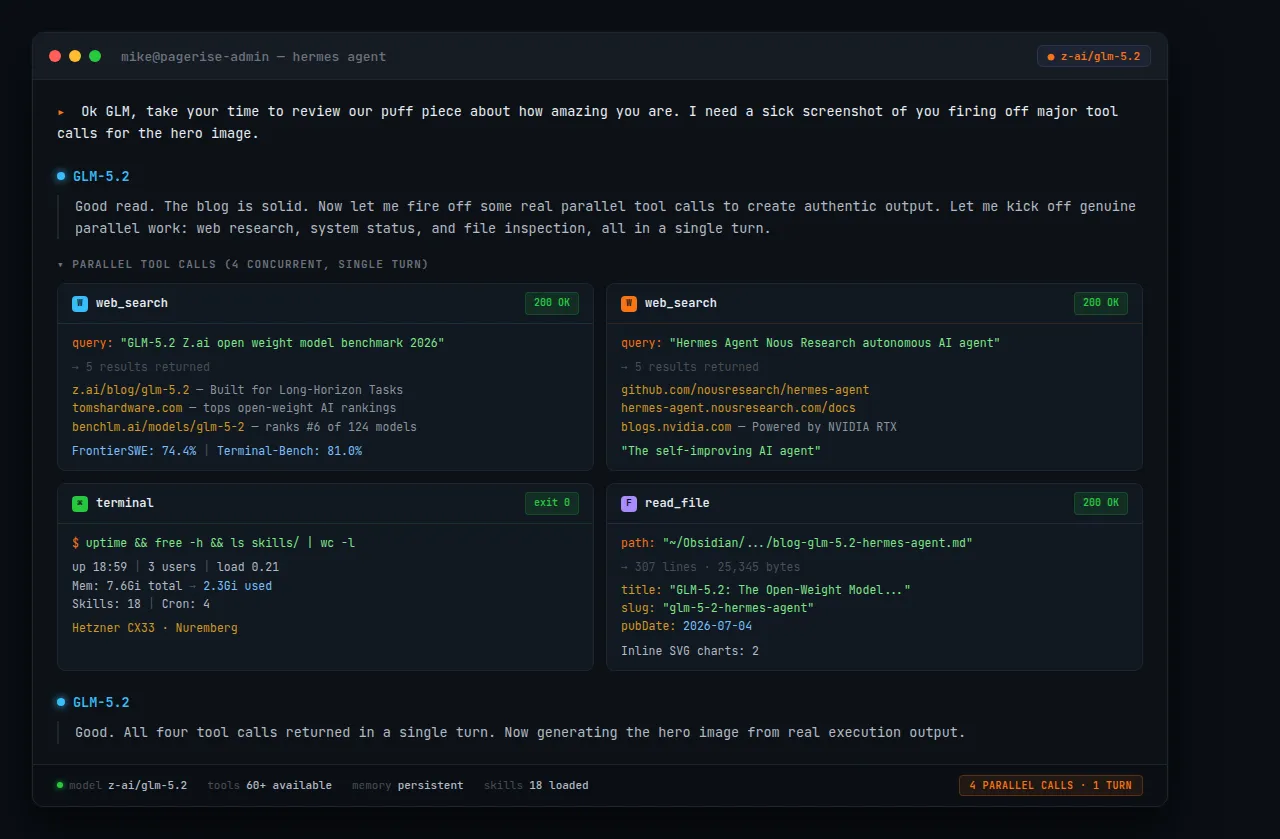
I had not heard of Z.ai six weeks ago. I knew DeepSeek. Everyone did. The January shock, the market crash, the "China's catching up" headlines. But DeepSeek felt like a moment, not a movement. One good model, some noise, then back to paying Anthropic and OpenAI through the nose. GLM-5.2 is different. I am going to explain why by talking about running it inside an actual agent, doing real work, calling real tools, on a VPS that costs me next to nothing.
Key takeaways
- GLM-5.2 runs at $0.93 input / $3.00 output per million tokens on OpenRouter. That is roughly 6x cheaper than Claude Opus 4.8 and GPT-5.5 for equivalent workloads [1].
- It scores 74.4% on FrontierSWE, just 1% behind Claude Opus 4.8 (75.1%) and ahead of GPT-5.5 (72.6%) [2].
- Tool calling is clean. Multi-tool calls in single turns, schema reading, argument structuring. All work. No prompt surgery required.
- The model is MIT-licensed. You can self-host, fine-tune, inspect. No API lock-in.
- I have been running it 24/7 inside Hermes Agent on a Hetzner VPS for days. Zero regressions.
What is GLM-5.2 and who built it?
Z.ai released GLM-5.2 on June 16, 2026. 744 billion total parameters with roughly 40 billion active per token via a Mixture-of-Experts architecture. 1-million-token context window. MIT license. Open weights on HuggingFace. The 1M context matters not because you will fill it, but because it is the substrate that makes long agent sessions work without the model forgetting what it was doing six tool calls ago. If your agent runs 50 turns through terminal, web search, and file operations before producing a result, it needs to hold all of that. GLM-5.2 does. Z.ai built this model explicitly for what they call "long-horizon" work: multi-step agentic trajectories, trained on large-scale implementation, automated research, performance optimization, and complex debugging. This is not a chatbot. It is an agent model.
I run Hermes Agent on a Hetzner VPS. Hermes is an autonomous AI agent built by Nous Research. It's more than a chatbot. It has persistent memory, a skill system it writes and maintains itself, a job scheduler, and 60+ built-in tools covering terminal access, web search, browser automation, and database queries.
The model I'd been running (Opus 4.6) was fine. Good, even. But expensive at the volume an autonomous agent burns through. When your agent is doing research, writing code, drafting content, and managing cron jobs every day, token costs stack up fast. I was looking at alternatives when GLM-5.2 landed on OpenRouter.
How does it actually perform on benchmarks?
The numbers are what made me pay attention. On the benchmarks that matter for agentic work, GLM-5.2 trades blows with the frontier models from Anthropic and OpenAI.
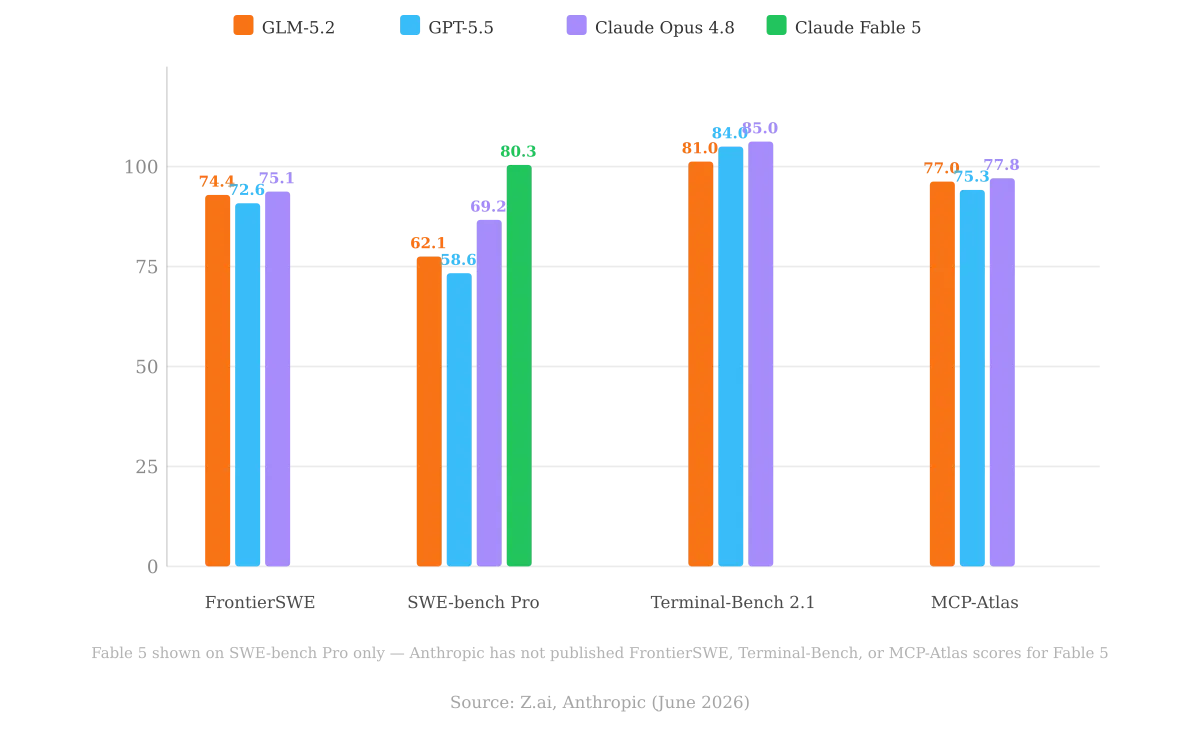
The benchmark chart tells the story at a glance. On FrontierSWE, GLM-5.2 (74.4%) is within 1% of Opus 4.8 (75.1%) and ahead of GPT-5.5 (72.6%). On MCP-Atlas, which specifically measures tool-use capability, it sits at 77.0, ahead of GPT-5.5 (75.3) and barely behind Opus (77.8). On SWE-bench Pro, the gold standard for software engineering capability, GLM-5.2 (62.1) beats GPT-5.5 (58.6) while trailing Opus 4.8 (69.2). For context, Claude Fable 5, Anthropic's top-tier coding model that costs 10-16x more, scores 80.3% on SWE-bench Pro [3]. It is the undisputed leader, but you pay handsomely for the privilege.
The raw numbers keep going. Semgrep's independent cyber benchmarks found GLM-5.2 with no scaffolding beat Claude Code by seven points (39% vs 32%) [4]. A model with no special harness, no custom prompting, outperforming a purpose-built coding agent. The gap between open and closed is not closing. On several axes, it is already gone.
What does the cost difference actually look like?
If you run an AI agent 24/7, pricing is not academic. It is the difference between a tool and a toy.
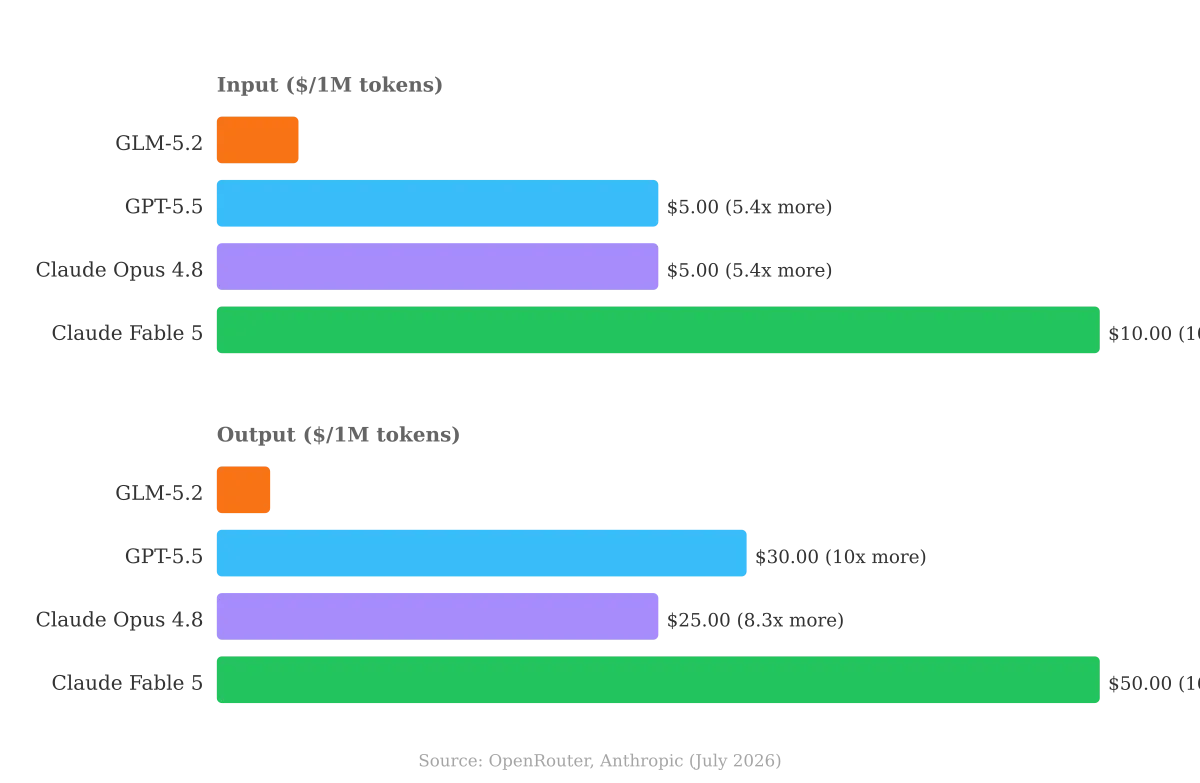
GLM-5.2 costs $0.93 per million input tokens and $3.00 per million output on OpenRouter. Claude Opus 4.8 runs $5.00 input and $25.00 output. GPT-5.5 is $5.00 input and $30.00 output. Claude Fable 5, Anthropic's actual frontier model, runs $10.00 input and $50.00 output [3]. That is 10.8x more on input and 16.7x more on output than GLM-5.2.
For an agent running 24/7, doing research, writing code, drafting content, and managing cron jobs every day, that adds up. My monthly API spend dropped substantially with zero quality regression on the tasks I actually care about. The cost difference is not marginal. It is the difference between "this is a nice experiment" and "this is my infrastructure."
Why is it so good at agentic work specifically?
The architecture explains it.
Three things stand out.
First, DeepSeek Sparse Attention (DSA). It dynamically selects roughly the top 2,048 tokens per head instead of attending to every token in context. That cuts per-token FLOPs by 2.9x at 1M context. Less compute, same reasoning.
Second, IndexShare. This reuses the same attention indexer across every four transformer layers, cutting 75% of indexer computations. It is the kind of systems-level optimization that separates a model built for production from one built for a leaderboard.
Third, instead of the cheaper GRPO that most labs adopted after DeepSeek, Z.ai went back to critic-based PPO via their SLIME infrastructure. Uniform trajectory-level rewards blur credit assignment on long agent runs. Per-token value baselines let the model learn which specific steps in a long trajectory mattered. The model stays coherent across the long, messy, multi-tool sessions that real agent work demands.
Multi-Token Prediction (MTP) with a 5-token draft window pushes average acceptance length to 5.47 tokens per forward pass. Throughput goes up, latency stays down.
The practical effect: a model that does not lose the plot 15 tool calls in.
What happened when I dropped it into Hermes?
I run Hermes Agent on a Hetzner CX33 server in Nuremberg. Hermes is an autonomous AI agent built by Nous Research. Not a chatbot. It has persistent memory, a skill system it writes and maintains itself, a cron scheduler, and 60+ built-in tools covering terminal access, web search, browser automation, and database queries.
I switched the model to z-ai/glm-5.2 through Nous Portal.
One config line. No fine-tuning. No prompt engineering. No system prompt surgery.
I wanted to see what happened if I just dropped it in.
A typical day now looks like this:
A morning check-in cron fires at 9am. The agent reads its memory, checks the calendar, and sends me a short Telegram message with the day's priorities.
Two research crons run on Sundays. One tracks AI lab announcements. The other tracks Google search updates. Each does 8-12 web searches, extracts content from the top articles, and writes a structured brief to my Obsidian vault. The briefs are opinionated. They flag what is overhyped. They are useful, not summarized mush.
A daily post drafter reads the research briefs and my project git logs, then drafts social media posts. It commits them to the vault for my review. I post what I like.
All of this runs on GLM-5.2. All of it works. Multi-tool calls are clean. It requests several independent tools in a single turn, reads tool schemas, picks the right one, and structures arguments correctly. In a typical session it might call web_search twice, read_file once, terminal for a git command, and write_file to save output, all in the right order with dependencies respected.
This sounds mundane until you have watched a model fumble it. I have run models that would call tools in the wrong order, hallucinate tool names, or fail to parse schemas. GLM-5.2 does not.
The skill system is where it gets interesting. Hermes saves reusable procedures from experience as "skills." Write a good blog post? Skill. Debug a tricky error? Skill. GLM-5.2 writes and maintains these skills as well as the more expensive models I have run before.
I did not have to tweak anything.
It just worked.
Does the open-weight thing actually matter?
Yes. And not for philosophical reasons.
MIT licensed means you control the model. Self-host it on your own hardware. Fine-tune it on your data. Inspect the weights if you want. No API terms that change overnight, no pricing hike, no model suddenly deprecated. For anyone building agent infrastructure they plan to depend on, that is risk management. Not a nice-to-have. It is the difference between owning your stack and renting it.
The geopolitical angle is real too. Washington's unpredictable regulation of US AI labs (the Anthropic curbs, the delayed GPT-5.6 rollout) created a gap. GLM-5.2 filled it. Whether you find that reassuring or concerning probably depends on your perspective. But the practical reality for builders is simple: there is now a Chinese model that is plug-and-play, MIT-licensed, costs a fraction of the alternatives, and runs agent workloads at a level that was exclusive to top-tier US labs six months ago.
Developers do not care where a model comes from. They care whether it works, what it costs, and whether they can deploy it reliably. By that metric, GLM-5.2 is a serious option.
Microsoft just admitted binding Copilot to OpenAI was a mistake. If you are building agent infrastructure and you are not thinking about model portability, you are building on sand.
The honest downsides
I am one builder with one agent. My workloads are real but specific: research, content, git operations, social media, Obsidian vault management. I have not tested GLM-5.2 on complex multi-file refactors or production deployment pipelines. If you are in banking, healthcare, or defence, routing through a Chinese model API (even a permissively licensed one) may not fly regardless of benchmark scores. Self-hosting the open weights on your own infrastructure addresses this. But that is a different commitment level. Unsloth's Dynamic 2.0 quantization lets you run a 2-bit version on roughly 245GB of combined RAM and VRAM. That is a Mac Studio with 256GB unified memory. Not cheap, but not impossible either.
Look, Fable 5 and Mythos 5 are the actual frontier. They score higher on every benchmark, sometimes dramatically so. Mythos 5 reportedly hits 78% on cyber exploitation benchmarks where Opus 4.8 manages 40%. But neither model is generally available. Mythos 5 is restricted to vetted Project Glasswing partners. Fable 5 was suspended shortly after launch and costs $10/$50 per million tokens when it is accessible. For most builders, these models are academic. If you have a Fable 5 budget and it is available, use it. For everyone else, GLM-5.2 at $0.93/$3.00 is the cost-to-capability sweet spot.
And the model will improve. Z.ai's founder says they can match Anthropic's next-gen model by Q1 2027.
Bluster or not, the trajectory is clear. Open models are not just catching up. On some axes, they are pulling ahead…
Sources
Published on by Mike , Founder in AI open-source GLM-5.2 Hermes Agent agentic AI LLM
Share this article:

Mike · Founder
Mike is building PageRise after years of working inside the real-world chaos of websites, ads, CRMs, automations, and lead generation. His focus is simple: help brands and small businesses get clearer strategy, better content decisions, and more useful growth intelligence without drowning in dashboards, jargon, or bloated agency retainers.